Pinterest ads suit businesses whose customers plan ahead: home, fashion, food, beauty, weddings, gifts and DIY. You need a Pinterest business account in a country where ads are available, a website, and the Pinterest tag if you want to measure sales or sign-ups. Start with one campaign, one clear objective and three to five vertical (2:3) images built around what people search for.
Pinterest behaves more like a search engine than a social feed. People come to plan: a kitchen, an outfit, a birthday, a garden. That makes it unusual among ad platforms, because your ad can meet someone while they’re still deciding what to buy, often weeks before they buy it. For a small business with visual products, that early moment is cheaper to reach than the last click on Google.
Is Pinterest right for your business?
It usually fits when three things are true:
- Your product is visual and looks good in a tall image: furniture, clothing, recipes, crafts, décor, cosmetics, travel.
- People plan the purchase. Seasonal and project-based buying (holidays, home projects, events) is where Pinterest is strongest.
- You can send people to a page that matches the Pin. A product or collection page, not a generic homepage.
It fits less well for urgent needs (an emergency plumber), complex B2B purchases, or products that are hard to show in a picture. If that’s you, search ads on Google are usually a better first channel; see Google Ads vs Meta Ads.
What you need before you start
- A Pinterest business account. Ads require one, and the country you pick when you first open Ads Manager sets your billing currency for good.
- A country where Pinterest ads are available. Pinterest lists about 40 countries where you can set up an ad account directly, and further markets served through partners. Check the ads overview page before you plan a campaign.
- The Pinterest tag on your website if you want to optimise for or measure purchases, sign-ups or other on-site actions. Without it, you can still run awareness and traffic campaigns, but you can’t see which Pins led to sales.
- Three to five images in 2:3 format (1000 × 1500 px is Pinterest’s recommendation).
Choosing an objective
Pinterest’s current objectives are brand awareness, video completion, consideration, leads and sales. For a first campaign, the choice comes down to what you can measure:
| Objective | Optimises for | Choose it when |
|---|---|---|
| Brand awareness | Getting your Pins seen | You’re new on Pinterest and want people to discover the brand. |
| Consideration | Pin clicks and outbound clicks | You want traffic to product pages and don’t have the tag yet. |
| Leads / Sales | Actions on your website, such as checkout or sign-up | The Pinterest tag is installed and recording those actions. |
| Video completion | Completed video views | You have strong vertical video and want it watched. |
A sensible path for a small shop: start with consideration to learn which Pins earn clicks, install the tag in parallel, then move your best Pins into a sales campaign once the tag has recorded a few weeks of purchases.
Creative that works on Pinterest
- Go vertical. Pinterest recommends a 2:3 ratio; taller images may be cropped in feeds.
- Show the product in use (the shirt on a person, the lamp in a room) rather than on a white background alone.
- Write titles for search. Titles can be 100 characters, but only the first 40 may show in feeds, so lead with the words people search: “Linen summer shirt”, not “Our new collection”. See ad character limits.
- Use the description (up to 800 characters). It isn’t shown in feeds, but Pinterest uses it to judge where your Pin is relevant.
- Plan ahead of the season. People plan summer outfits in spring and holiday gifts in autumn. Pinterest Trends shows when searches for a topic rise.
Budgets and expectations
Start small and give the campaign enough time to learn: one campaign, one ad group, a daily budget you’re comfortable losing while you learn, and at least two to three weeks before judging it. Pinterest is an earlier-funnel channel, so judge it on clicks and saves in the first weeks and on tagged sales over a longer window, not on next-day revenue.
How to measure it honestly
- Use the tag for conversions and UTM parameters on every link, so your own analytics can see Pinterest traffic too.
- Compare like with like. Pinterest often finds people earlier in the buying journey, so last-click reports undercount it.
- Keep a simple log of which images and titles you ran and what happened. That record is worth more than any single campaign.
Running a Pinterest campaign with OrivenAI
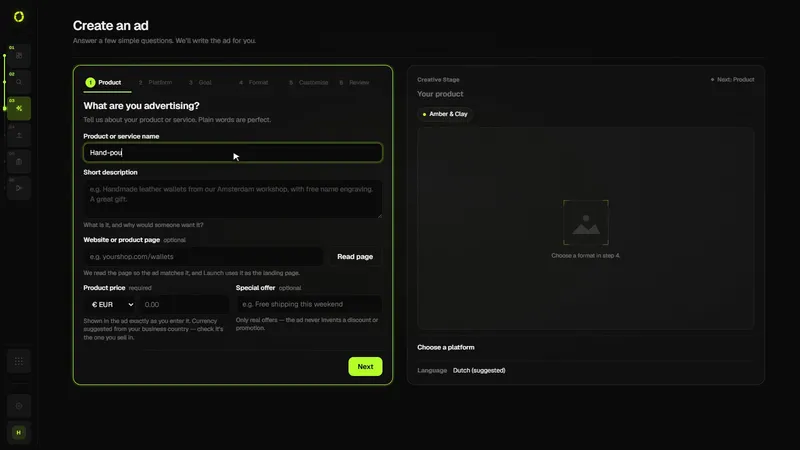
In Create, choose Pinterest Ads and describe what you’re selling. OrivenAI drafts the Pin title, description and alt text, generates a vertical image (or uses one you attach), and prepares the campaign structure. Before anything is published, Launch checks what Pinterest will need:
- The country to target. It comes from your business profile or your choice; OrivenAI never assumes one.
- Your daily budget, which you always set yourself.
- For sales and leads campaigns, a Pinterest tag on your ad account. Without one, OrivenAI won’t publish a conversion campaign it can’t measure.
The campaign is created on Pinterest paused, so you can review it in Pinterest Ads Manager and switch it on when you’re ready. See OrivenAI for Pinterest Ads.
Sources
Official documentation this guide relies on, last checked . Platforms change their rules often; check the source before you rely on a number.