PPC automation means letting software make routine changes to pay-per-click campaigns, such as bids, budgets, pausing and alerts, based on rules or models instead of manual checks. The goal is faster, more consistent decisions, while people keep control over the limits.
The four kinds of PPC automation
“Automation” in paid media usually means one of four things, and most accounts use several at once:
1. Platform-native optimization
The ad networks automate a great deal themselves. Google Ads smart bidding sets bids per auction toward a goal such as target CPA or target ROAS; Performance Max chooses placements across Google’s inventory; Meta’s Advantage+ options automate audiences and placements. This automation is powerful but works inside one network and toward the goal you give it.
2. Rule-based automation
Rules are explicit “if this, then that” statements: if a campaign’s CPA is above €40 for the period, pause it. Google Ads has built-in automated rules, and third-party tools add rules that work across accounts. Rules are predictable and easy to audit, but only as good as the thresholds you choose.
3. Scripts
Google Ads scripts let you write JavaScript that runs on a schedule against your account. They can do almost anything a rule can and more, but they need someone who can write and maintain code.
4. AI-assisted workflow automation
Newer tools use AI for the work around campaigns: drafting ad copy and creative, building campaign structures from a brief, summarizing performance, or suggesting changes. This speeds up the slowest parts of the workflow rather than the bidding itself.
Rule-based vs AI automation
The difference is less about “smart vs dumb” and more about who decides, and how visibly.
- Rule-based automation does exactly what you wrote. You can read every rule, predict every action and explain every change afterwards. Its weakness is rigidity: a fixed threshold can be wrong for a new campaign or a seasonal peak.
- AI-driven automation adapts to patterns humans would miss and handles more variables at once. Its weakness is opacity: when a model moves budget, it can be hard to tell why, and harder to stop it from doing it again.
In practice the strongest setups combine them: the ad networks’ machine learning handles auction-level bidding, AI speeds up creative and campaign building, and readable rules handle the business decisions, such as when to stop spending, where budget may go and when a human must approve.
What to automate first
- Alerts. Notifications when spend, CPA or conversions cross a threshold. Zero risk, immediate value.
- Pausing clear losers. Campaigns or ads that spend without converting after a reasonable amount of data.
- Small budget shifts. Modest increases for campaigns that consistently meet your targets, capped so a single change can’t double spend.
- Creative and campaign drafting. Use AI to produce more variations to test, while you still review before anything publishes.
Risks to manage
- Automating on bad data. If conversion tracking is broken, every rule that uses conversions or CPA is wrong. Verify tracking first.
- Reacting to noise. Judging a campaign on one day or a handful of clicks leads to pausing winners. Use enough data and sensible look-back periods.
- Conflicting automations. A budget rule fighting the network’s own budget optimization, or two tools changing the same campaign, makes results impossible to read.
- Learning-phase resets. Frequent, large changes can reset the ad networks’ learning and make performance less stable.
- No audit trail. If you can’t see what changed and why, you can’t improve the rules.
Automation should save you time without taking away your ability to explain what happened in your account.
PPC automation in OrivenAI
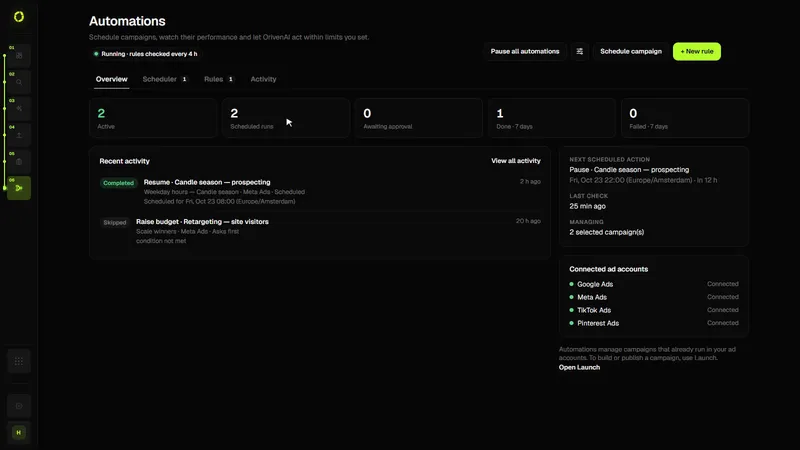
OrivenAI’s Automations are rule-based by design, with no AI deciding what happens. You write rules on metrics such as ROAS, CPA, CPC, CTR, conversions and spend, or schedule campaigns to switch on and off at set times; actions can pause or resume a campaign, change its daily budget within limits, notify you, or request approval first. Rules wait for enough data, budget changes are capped, and there’s an activity log of what happened. AI is used where it’s strongest: turning a brief into a full campaign and creative in Create. Read more about OrivenAI’s PPC automation.
Sources
Official documentation this guide relies on, last checked . Platforms change their rules often; check the source before you rely on a number.